Call us today (732) 230-7552
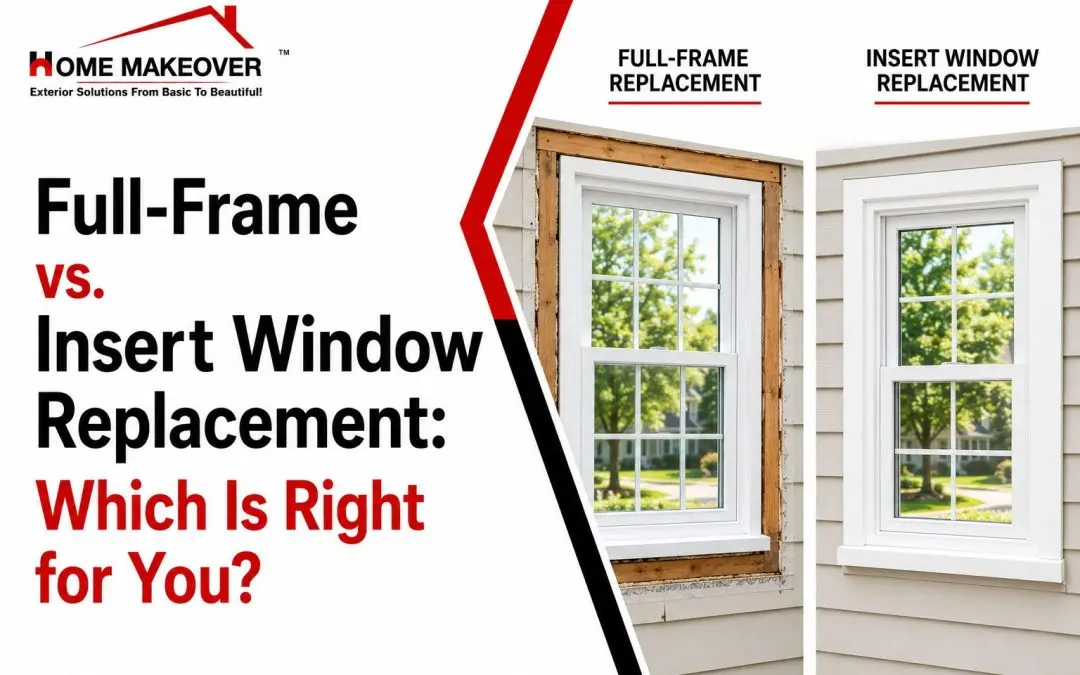
The full-frame vs insert window replacement decision is one of the most important choices in any NJ window project. Get it right, and you save money, time, and disruption. Get it wrong, and you may be left with a window that leaks, does not seal properly, or fails within a few years because an underlying problem was never addressed.
Most NJ homeowners hear about insert replacements from contractors quoting a lower price and assume it is always the smarter option. It often is. But not always. The method that is right for your home depends entirely on the condition of your existing window frames.
This guide breaks down exactly what each method involves, what it costs in NJ in 2026, the pros and cons of each, and the specific situations where one method is clearly the better choice.
Full-Frame vs. Insert Window Replacement at a Glance
| Feature | Insert (Pocket) Replacement | Full-Frame Replacement |
|---|---|---|
| What is removed | Old sash and hardware only | Entire window including frame, trim, sill, and jambs |
| What stays | Existing frame, interior and exterior trim | Nothing — rough opening is exposed |
| Frame condition required | Must be structurally sound, no rot | Works for any frame condition |
| Glass area | Slightly smaller (new frame sits inside old) | Full-size opening maximized |
| Energy efficiency | Good if existing frame is tight | Better — new flashing, insulation, and frame seal |
| Installation time (NJ) | 30 to 60 min per window | 1 to 3 hours per window |
| Cost (NJ, 2026) | $350 – $900 per window installed | $600 – $1,800+ per window installed |
| Disruption | Minimal — trim stays intact | Higher — trim removed, wall may be exposed |
| Best for | Sound frames, 1 to 20 years old | Rotted, damaged, or very old frames |
| Can change window size? | No | Yes |
What Is an Insert (Pocket) Window Replacement?
An insert replacement, also called a pocket replacement, involves sliding a new pre-built window unit into your existing frame without removing the surrounding trim, casing, or structural framing. The old sash, glass, hardware, and weatherstripping are removed. The new unit then fits inside the existing frame opening and is secured in place.
Because the exterior siding, interior casing, and trim all stay in place, insert replacement is significantly less disruptive and less expensive than a full-frame job. Most NJ window crews can complete 8 to 12 insert replacements in a single day.
Insert Replacement Pros
- Lower cost — typically 25 to 50 percent less than full-frame replacement for the same window
- Less disruption to your home, with no damage to existing interior or exterior trim
- Faster installation, often completed in one day for a full home project
- Preserves existing trim and casing, which is important for homes with custom millwork or historic character
- Less mess and cleanup compared to full-frame removal
Insert Replacement Cons
- Slightly smaller glass area because the new frame sits inside the existing one, reducing the visible glass by 1 to 2 inches on each side
- Cannot address hidden rot, water damage, or structural issues inside the existing frame that are not visible from the surface
- If the existing frame has any warping, soft spots, or moisture damage, the new insert may not seal properly and will fail prematurely
- Cannot change the size, shape, or style of the window opening
| NJ Context: Insert replacement is the right choice for most NJ homes built between 1985 and 2010 where the existing frames are structurally intact but the sashes, glass, and hardware have reached the end of their useful life. A licensed NJ contractor should inspect each frame before confirming this method is appropriate. |
What Is a Full-Frame Window Replacement?
A full-frame replacement removes everything, including the glass, sash, frame, sill, jambs, and all interior and exterior trim, right down to the rough opening in the wall framing. A completely new window unit with its own frame is then installed from scratch, with fresh flashing, insulation, caulk, and trim.
Full-frame replacement takes longer and costs more, but it gives the contractor the ability to inspect and repair the surrounding wall cavity, install new vapor barrier and insulation, and apply fresh flashing that protects against water infiltration for decades.
Full-Frame Replacement Pros
- Exposes the rough opening for a complete inspection of surrounding framing, insulation, and moisture barriers
- Any rot, mold, or water damage discovered behind the frame can be repaired before the new window goes in
- Fresh flashing, vapor barrier, and perimeter insulation provide maximum protection against future water infiltration
- Full glass area is maximized since there is no existing frame constraining the new unit size
- Allows you to change the size, shape, or style of the window opening
- Better long-term energy performance because the entire perimeter is re-sealed from scratch
Full-Frame Replacement Cons
- Costs 25 to 50 percent more than insert replacement due to additional labor, materials, and trim work
- More disruptive installation requiring removal of interior and exterior trim and casing
- Takes longer, typically 1 to 3 hours per window versus 30 to 60 minutes for an insert
- Interior walls near the window may need minor patching or repainting after casing reinstallation
| NJ Context: Full-frame replacement is strongly recommended for NJ homes built before 1980, homes with wood frames showing any signs of rot or moisture staining, and any window where water has been entering the wall cavity. Many older Monmouth and Middlesex County homes have original wood frames that have absorbed decades of NJ humidity and freeze-thaw stress. |
How to Choose Between Full-Frame and Insert Replacement in NJ?
The single most important factor is the condition of your existing window frames. Everything else, including cost and timeline, should be secondary to this assessment.
| Your Situation | Recommended Method | Why? |
|---|---|---|
| Frame is solid, no rot, no soft spots | Insert replacement | Sound frame supports a pocket install at lower cost |
| Frame shows any rot, soft spots, or mold | Full-frame replacement | Rot must be addressed before a new window is installed |
| Water stains on wall near window | Full-frame replacement | Moisture has likely entered the wall cavity |
| Home built before 1980 with original frames | Full-frame replacement | Wood frames in older NJ homes often have hidden moisture damage |
| Home built 1985-2010, frames inspected as sound | Insert replacement | Budget-friendly option where frames pass inspection |
| Want to change window size or style | Full-frame replacement | Only method that allows rough opening modification |
| Historic home with significant original trim | Insert replacement | Preserves irreplaceable architectural millwork |
| Mold or mildew visible around the frame | Full-frame replacement | Mold behind the frame requires removal and treatment |
The right approach is not always obvious from the outside. A licensed NJ contractor should inspect each frame individually before confirming the method. In some homes, insert replacement is right for most windows, but full-frame replacement is needed for one or two that show moisture damage. A mixed approach is common and the most cost-effective strategy.
Cost Comparison: Full-Frame vs. Insert Replacement in NJ (2026)
| Method | Labor Cost (NJ) | Total Installed Cost (NJ, 2026) | Typical Time Per Window |
|---|---|---|---|
| Insert (pocket) replacement | $100 – $300 per window | $350 – $900 per window | 30 – 60 minutes |
| Full-frame replacement | $300 – $800 per window | $600 – $1,800+ per window | 1 – 3 hours |
Insert replacement typically costs 25 to 50 percent less than full-frame replacement for the same window size and material. On a 10-window project in NJ, that difference can range from $2,500 to $9,000 depending on window size, material, and specific labor requirements. However, choosing an insert when full-frame is needed always costs more in the long run when moisture damage, failed seals, or mold remediation is required later.
Frequently Asked Questions
Full-Frame vs. Insert Window Replacement: What’s the Difference?
Insert replacement slides a new window unit into the existing frame without removing surrounding trim or structure. Full-frame replacement removes everything down to the rough wall opening and installs a completely new frame, flashing, and window unit from scratch. Insert is less expensive and less disruptive when the existing frame is sound. Full-frame is required when the frame is rotted, water-damaged, or when you want to change the window size.
How do I know if my NJ home needs full-frame or insert replacement?
Press firmly on the corners and sill of your existing window frame from inside the home. If any area feels soft, spongy, or gives way, the frame has rot and full-frame replacement is required. Check for water staining on the wall near the window, peeling paint on the exterior trim, or visible mold around the frame edges. Any of these signs indicate moisture has entered the frame and insert replacement is not appropriate. A licensed NJ contractor can inspect and confirm the condition during a free estimate.
Is insert window replacement less energy efficient than full-frame?
Not necessarily. Insert replacement can achieve excellent energy performance when the existing frame is tight, properly sealed, and in good condition. The new window unit installed in an insert replacement uses the same glass packages and weatherstripping as a full-frame unit. Where insert replacement can fall short on energy performance is when the existing frame has gaps, has absorbed moisture, or has degraded insulation in the wall cavity that goes unaddressed. Full-frame replacement allows these issues to be corrected.
Can an insert replacement be done on an older NJ home?
Yes, in some cases. Age alone does not determine whether insert or full-frame is appropriate. The condition of the frame is what matters. Some older NJ homes have original wood frames in excellent condition that fully support an insert replacement. Others have frames that look fine from the surface but have hidden rot or moisture damage. A thorough frame inspection by a licensed NJ contractor is always recommended before committing to either method on an older home.
How long does each method take for a full-home NJ window project?
For a standard NJ home with 10 to 15 windows, insert replacement typically takes one to two days from start to finish. Full-frame replacement on the same home usually takes two to four days due to the additional trim removal, structural inspection, insulation work, and trim reinstallation involved. Both methods can generally be completed with no overnight exposure of the home’s interior to the elements.
Ready to Replace Your Windows the Right Way in New Jersey?
At Home Makeover LLC, our exterior home repair services start with a thorough frame-by-frame inspection before we recommend insert or full-frame replacement for any NJ home. We never upsell full-frame when an insert is appropriate, and we never use an insert when the frame condition requires a complete replacement.
We are fully licensed and insured, backed by 20+ years of experience and 200+ five-star Google reviews across Monmouth, Middlesex, and Mercer Counties. Every project starts with a free in-person inspection in 2026. Flexible financing is available for qualifying projects.

About the Author: Jeffrey W. Nero
Jeffrey W. Nero is a home improvement expert with over 20 years of experience serving homeowners in New Jersey. As the owner of Home Makeover™, Jeff combines quality craftsmanship with a deep understanding of local needs. From roofing and siding to deck remodels, Jeff has helped thousands of homeowners bring their visions to life. His commitment to excellence and customer satisfaction makes him a trusted partner in transforming homes across Central NJ.