 Call us today (732) 230-7552
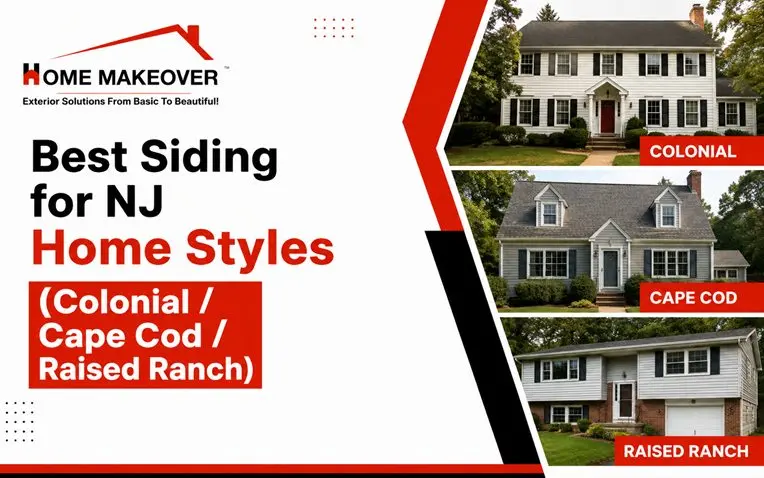
Colonial home siding ideas are the most searched siding topic in New Jersey – and for good reason. Colonial homes are the most common residential style across Monmouth, Middlesex, and Mercer Counties. But NJ homeowners also deal with Cape Cods, raised ranches, and split-levels, each with its own proportions, rooflines, and architectural character that demand different siding approaches.
Choosing the wrong siding style or material for your home’s architecture is one of the most common exterior mistakes NJ homeowners make. A siding profile that works beautifully on a two-story colonial can look awkward on a low-slung raised ranch. A color that suits a classic Cape Cod becomes boring on a modern split-level.
This guide breaks down the best siding materials, profiles, and color strategies for the three most common NJ home styles in 2026. Each section gives you specific recommendations, not generic advice.
Why Your Home’s Architectural Style Drives Every Siding Decision
Siding is not just weather protection. It is the visual frame of your home’s architecture. The right siding enhances the features your home already has. The wrong siding works against them.
In NJ’s dense residential neighborhoods, siding choices also affect how your home reads against its neighbors. A colonial on a street of colonials that uses an inappropriate profile or clashing color stands out for the wrong reasons. One that enhances its natural symmetry and uses complementary materials adds lasting curb appeal and resale value.
Vinyl siding is the most widely installed material across all three NJ home types covered in this guide. It handles NJ’s freeze-thaw cycles well, requires no painting, and is available in every profile and color combination discussed below. For homes where premium aesthetics or historic accuracy matter more than cost, James Hardie fiber cement is the leading upgrade option.
Colonial Homes
Colonial Home Siding Ideas for NJ
Colonial homes are defined by symmetry: a centered front door, evenly spaced windows, and a balanced facade that reads the same on both sides. Your siding choice must work with that symmetry, not compete against it. The goal is to enhance the architecture’s natural formality.
Best Siding Profile: Horizontal Lap
Traditional horizontal lap siding – also called clapboard – is the quintessential choice for colonial homes. The long, clean horizontal lines echo the home’s balanced proportions and create a timeless look that does not date itself. Modern vinyl and fiber cement lap siding delivers this look with zero maintenance and significantly better durability than original wood clapboard.
Profile width matters. A 4-inch or 4.5-inch Dutch lap exposure suits most standard colonial homes. A wider 5-inch or 6-inch exposure gives a bolder, more contemporary feel while still reading as traditional.
Mixing Profiles: Gable and Story Breaks
Colonial homes offer two great opportunities for profile mixing. First, the gable ends above the second floor can be finished in a different profile, most commonly cedar shake or board and batten, to add texture and visual interest without breaking the symmetry of the main facade. Second, a story break using a distinct material or color band between the first and second floor adds dimension to taller two-story colonials.
| NJ Style Note: Colonials in Freehold, Middletown, and Old Bridge commonly use white or light gray lap siding on the main body with a contrasting shake accent in the gable. This is the single most requested colonial siding combination at Home Makeover LLC across Monmouth County. |
Best Colors for Colonial Homes in NJ
Colonial homes have always favored neutral palettes that emphasize their symmetrical structure rather than calling attention to color. The most effective approach is a light or medium body color paired with crisp white trim.
| Body Color | Trim Color | Character |
|---|---|---|
| Classic white | Bright white or off-white | Timeless, traditional, universally appropriate |
| Soft gray | White | Modern colonial, clean, popular in 2026 NJ markets |
| Warm beige / greige | White or cream | Approachable, neutral, broad appeal |
| Navy blue | White | Bold but classic, strong curb appeal |
| Sage green | White | Fresh, popular in shore-adjacent NJ towns |
| Deep charcoal | White or light gray | Contemporary colonial, high contrast impact |
Cape Cod Homes
Cape Cod Siding Ideas for NJ
Cape Cod homes sit low to the ground with steep rooflines, prominent dormers, and a modest footprint that reads as cozy and charming rather than formal. The right siding for a Cape Cod works with its horizontal proportions and natural informality rather than imposing a colonial’s formality on a fundamentally different shape.
Best Siding Profile: Shingle or Narrow Lap
Cedar shingle-style siding is the most historically accurate and visually appropriate choice for Cape Cod homes. It references the original coastal New England origin of the style and naturally suits the low, wide proportions of the home. Modern vinyl and fiber cement shingle-style siding delivers this look without the rot, paint, and splitting maintenance that wood shingles require in NJ’s climate.
If budget is a concern, narrow-exposure horizontal lap siding, at 3.5 to 4 inches, gives Cape Cod homes a proportionate look that suits their scale better than the wider lap used on colonials.
Dormers: The Cape Cod’s Signature Detail
Dormers are the defining feature of Cape Cod homes and deserve specific attention in any siding project. Common approaches in NJ include finishing dormers in a contrasting material, most often shingle-style siding or board and batten, while the main body uses standard lap. This picks up on the dormer as an architectural element rather than letting it blend into the roofline.
| NJ Style Note: Cape Cod homes in shore-adjacent NJ towns like Spring Lake, Avon-by-the-Sea, and Bay Head commonly use natural-gray weathered shingle aesthetics. Vinyl shingle siding in weathered gray or driftwood tones is the no-maintenance way to achieve this look without the upkeep of actual wood shingles. |
Best Colors for Cape Cod Homes in NJ
- Weathered gray or driftwood – most authentic to the Cape Cod coastal tradition
- Warm white or cream with black shutters – the most popular Cape Cod combination in NJ
- Soft sage or pale blue-gray – fresh, coastal, suits NJ shore communities
- Barn red with white trim – traditional New England callback, stands out strongly in inland NJ neighborhoods
Raised Ranch Homes
Raised Ranch Siding Ideas for NJ
Raised ranch homes present the most challenging siding design problem of the three. Their low, horizontal profiles can look flat and uninspired with poorly chosen siding. The right strategy uses material contrast, color, and profile variation to add vertical interest and visual weight that the architecture lacks on its own.
The Two-Tone Strategy: Most Effective for Raised Ranches
The most impactful siding approach for raised ranch homes in NJ is a two-tone material or color treatment that distinguishes the lower level from the upper. The most common and effective approach is a stone or brick veneer, or a board-and-batten accent on the lower level, combined with lap or shake siding on the upper level. This breaks the horizontal monotony and gives the home visual weight at the base.
Stone veneer on the lower front elevation of a raised ranch is the most popular upgrade Home Makeover LLC installs on this home type across Middlesex County. It transforms the proportions of the home entirely and dramatically improves curb appeal and resale value.
Profile Choice: Avoid Wide Horizontal Lap Alone
Wide horizontal lap siding used alone on a raised ranch emphasizes the home’s already strong horizontal lines and makes it look flatter and lower. If using lap siding as the primary material, pair it with a board-and-batten accent on the garage section or gable end to introduce vertical lines that counterbalance the home’s low profile.
| NJ Style Note: Raised ranches in Edison, South Brunswick, and Piscataway neighborhoods commonly suffer from plain vinyl that emphasizes how flat the home reads. The single most transformative upgrade is replacing the lower-level siding with a contrasting material. Stone veneer or board and batten on the lower section of a raised ranch can add $15,000 to $30,000 in perceived value, according to NJ real estate professionals. |
Best Colors for Raised Ranch Homes in NJ
- Upper: Warm taupe or greige / Lower: Natural stone or charcoal board and batten – most popular upgrade combination
- Upper: White / Lower: Charcoal gray – strong contrast, contemporary feel
- Upper: Sage green / Lower: Stone veneer – organic, natural, works especially well with landscaping
- Upper: Navy / Lower: White board and batten – nautical reference, strong in shore-adjacent NJ
Best Siding Materials for NJ’s Climate: Quick Reference
Regardless of home style, material choice affects durability, maintenance, and long-term cost. NJ’s four-season climate – freeze-thaw winters, humid summers, coastal salt air – is harder on siding than most national guides account for.
| Material | NJ Durability | Maintenance | Best Style Match | Cost (NJ Installed) |
|---|---|---|---|---|
| Vinyl | Good - freeze-thaw resistant | Very low | All three NJ home types | $4 – $8 per sq ft |
| Insulated vinyl | Better - adds R-value | Very low | Colonial, raised ranch | $6 – $10 per sq ft |
| James Hardie fiber cement | Excellent - resists NJ climate | Low - repaint every 15 yrs | Colonial, Cape Cod | $9 – $14 per sq ft |
| Cedar shake (vinyl/fiber cement) | Good | Very low (synthetic) | Cape Cod, Colonial gables | $8 – $13 per sq ft |
| Board and batten | Good - vinyl or fiber cement | Very low | Raised ranch accent, Cape Cod | $7 – $12 per sq ft |
| Stone veneer | Excellent - highly durable | Very low | Raised ranch lower level | $15 – $30 per sq ft |
Frequently Asked Questions
What siding looks best on a colonial house?
Horizontal lap siding in vinyl or fiber cement is the most architecturally appropriate siding for a colonial home. It mirrors the traditional clapboard siding that defined colonial architecture and complements the home’s symmetrical proportions. White, soft gray, or warm beige with white trim are the most timeless color combinations. For added dimension, a cedar shake or board and batten accent in the gable ends adds texture while maintaining the home’s formal character.
What is the best color siding for a colonial home?
The most effective siding colors for colonial homes are neutral tones that emphasize the home’s symmetry rather than competing with it. Classic white with bright white trim is the most timeless choice. Soft gray, warm greige, and navy blue with white trim are the most popular colonial siding combinations in NJ in 2026. The key principle is to use a light-to-medium body color with crisp white or off-white trim that outlines the windows, entryway, and architectural details clearly.
What type of siding is best for New Jersey?
Vinyl siding is the most popular and practical siding choice for NJ homes due to its ability to handle the state’s freeze-thaw cycles, humid summers, and coastal salt air without rotting, cracking, or requiring repainting. James Hardie fiber cement is the premium alternative, offering superior durability and a more authentic wood appearance for homeowners who want higher-end aesthetics. Insulated vinyl, which adds a layer of foam backing, is the best choice for NJ homeowners prioritizing energy efficiency alongside low maintenance.
Which siding color is trending for homes in 2026?
In NJ in 2026, the most popular siding colors are soft gray, warm greige, and deep charcoal, replacing the bright whites that dominated the previous decade. Nature-inspired tones like sage green and muted blues are gaining significant ground in Monmouth County, particularly in shore-adjacent communities. Classic white remains the most reliably safe choice for colonial homes going on the market. Dark charcoal and navy are trending strongly for raised ranch and split-level homes where homeowners want to add visual weight and modernity to a low-profile architecture.
Ready to Upgrade Your NJ Home’s Siding?
At Home Makeover LLC, our exterior home repair services help homeowners across Monmouth, Middlesex, and Mercer Counties choose the right siding material, profile, and color for their specific home style and neighborhood. Whether your home is a colonial, Cape Cod, raised ranch, or split-level, we match the right approach to your architecture and budget.
We are a VSI Certified installer, fully licensed and insured, backed by 20+ years of experience and 200+ five-star Google reviews. Every project starts with a free in-person consultation. Flexible financing is available for qualifying projects in 2026.

About the Author: Jeffrey W. Nero
Jeffrey W. Nero is a home improvement expert with over 20 years of experience serving homeowners in New Jersey. As the owner of Home Makeover™, Jeff combines quality craftsmanship with a deep understanding of local needs. From roofing and siding to deck remodels, Jeff has helped thousands of homeowners bring their visions to life. His commitment to excellence and customer satisfaction makes him a trusted partner in transforming homes across Central NJ.